
Klan Intimidation
Vote and Die

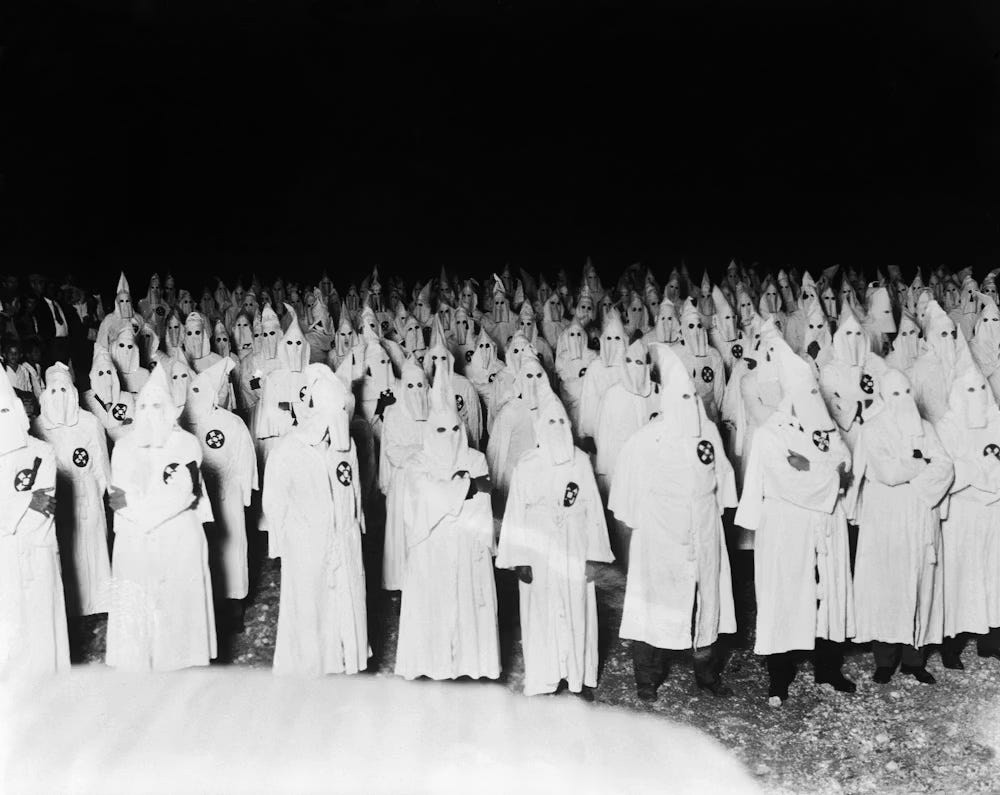
The Ku Klux Klan did not rise in Florida during the 1930s because Black people were powerless.
They rose because Black people were surviving.
And survival itself was seen as a threat.
Look closely at these photographs.
Hundreds of men dressed like ghosts.
Faces hidden.
Standing in formation under the dark Florida sky.
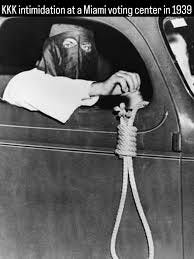
Then the second image:
a hooded Klansman sitting casually beside a car near a Miami voting center.
That second image tells you everything.
Because the Klan was never just about hatred.
It was about control.
And in 1930s Florida, white America believed it was losing control.
By the time these photos were likely taken, Black Floridians had already endured slavery, Reconstruction, lynching campaigns, segregation laws, and decades of political suppression. But despite all of it, Black communities across Florida were still organizing.
Still voting.
Still building businesses.
Still creating churches.
Still forming newspapers.
Still demanding citizenship in a country that only wanted their labor.
That terrified the Klan.
Miami in particular was changing rapidly during this period.
The city was exploding economically.
Hotels were rising.
Railroads expanded.
Agriculture boomed.
Tourism transformed South Florida into a national destination.
And Black labor built much of it.
African Americans from the Deep South.
Black Bahamians arriving through Caribbean migration routes.
Afro-Caribbean workers looking for opportunity.
Together, they helped construct modern Miami while being systematically locked out of the wealth they created.
But something else happened too.
Black neighborhoods like Overtown became cultural and economic centers.
Businesses emerged.
Music scenes developed.
Political organizations formed.
Mutual aid networks strengthened.
Overtown would eventually become known as “the Harlem of the South.”
And that scared white supremacists more than anything.
Because segregation only works if the people trapped inside it appear broken.
But Black Miami was alive.
The Great Depression made racial tensions even worse.
Economic collapse pushed many poor white Americans deeper into fear and resentment. Politicians and white supremacist organizations redirected that anger toward Black communities, immigrants, Catholics, Jews, and anyone else who threatened the racial hierarchy.
The Klan became the enforcement wing of that fear.
Not just through violence.
Through spectacle.
That is what the robes are.
Spectacle.
The uniforms.
The marches.
The rallies.
The nighttime ceremonies.
It was political theater designed to send a message:
“We still control this place.”
And nowhere was that message more important than the ballot box.
That second image — the armed intimidation near a voting center — reveals the real purpose of the Klan in the Jim Crow South.
Prevent Black political participation at all costs.
Because voting represented possibility.
If Black Floridians voted in large numbers, they could influence sheriffs, judges, school systems, local economies, and eventually state politics itself.
The Klan understood something America still struggles to admit:
Black political power has always been treated as dangerous in the United States.
That is why voter suppression became such an obsession.
Poll taxes.
Literacy tests.
White primaries.
Economic retaliation.
Lynchings.
And when all of that was not enough?
The hoods came out.
What makes these images historically important is that they accidentally reveal weakness.
At first glance, the Klan looks powerful here.
But historically, extremist movements often become most visible when they feel threatened.
These rallies were not simply celebrations of dominance.
They were panic responses to social change.
Florida in the 1930s was becoming more urban.
More international.
More Caribbean.
More Black.
More politically unpredictable.
And beneath every hood was fear.
Fear that Reconstruction had not truly died.
Fear that Black communities would gain economic independence.
Fear that demographic changes would weaken white political monopoly.
Fear that democracy, if fully applied, would permanently alter the South.
That fear never completely disappeared.
In many ways, these photographs feel disturbingly modern.
Because the same anxieties still echo through American politics today:
fear of demographic change,
fear of immigration,
fear of Black voting power,
fear of urban multiculturalism,
fear disguised as “protecting tradition.”
These images are horrifying.
But they also contain proof of something powerful:
Black communities in Florida survived long enough, organized long enough, and fought hard enough to make white supremacy feel endangered.
And history shows us something important about systems built on domination:
They become loudest when they realize they may not last forever.