Freedman Schools
How education led to a second emancipation.

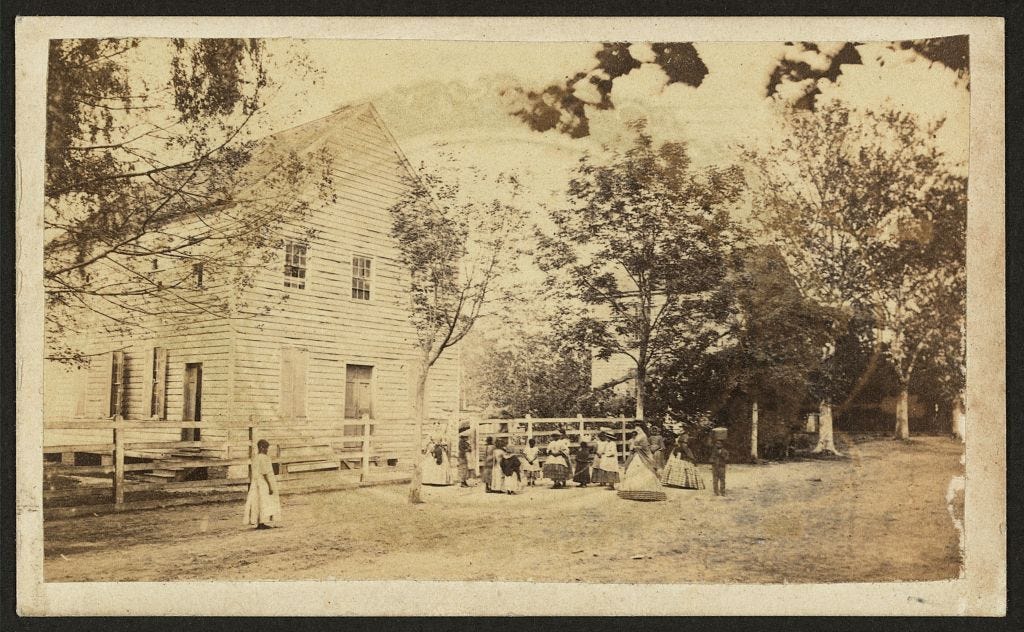
This is a Freedmen’s school in Charleston, South Carolina. And what you are really looking at is a battlefield after the smoke cleared.
The war had ended only a few years earlier. Four million enslaved people had been released into a nation that had never intended for them to read, write, vote, inherit, or fully belong. In South Carolina, enslaved Africans had once outnumbered white people in many regions of the state. Charleston itself had been one of the great ports of the slave trade. Human beings were bought there the same way cotton or rice was bought.
And yet here — in this quiet image — you see something revolutionary.
Education.
Not education as a luxury, but as survival.
The people gathered outside this school understood something immediately after emancipation: freedom without literacy was fragile. A man who cannot read a labor contract can be cheated. A woman who cannot read a law cannot defend herself beneath it. A child who cannot read history is condemned to inherit whatever lies are handed down to him.
That is why freedmen schools spread across the South with astonishing speed after 1865.
Many of these schools were built through the labor of formerly enslaved people themselves. Northern missionaries came south. Black churches organized classes. Teachers risked beatings and murder to educate newly freed families. Some lessons happened in abandoned churches. Others in army barracks. Sometimes beneath trees.
And in Charleston, the hunger for literacy was immense.
You can almost feel it in this image. The stiffness of the figures. The careful clothing. The children standing still for the camera because photographs themselves were rare enough to feel ceremonial. For many Black families, attending school was not simply about learning letters. It was proof that slavery had not destroyed the mind.
There is another thing hidden in this photograph.